14 October 2026
Unit train vs manifest train: how to tell them apart in satellite imagery
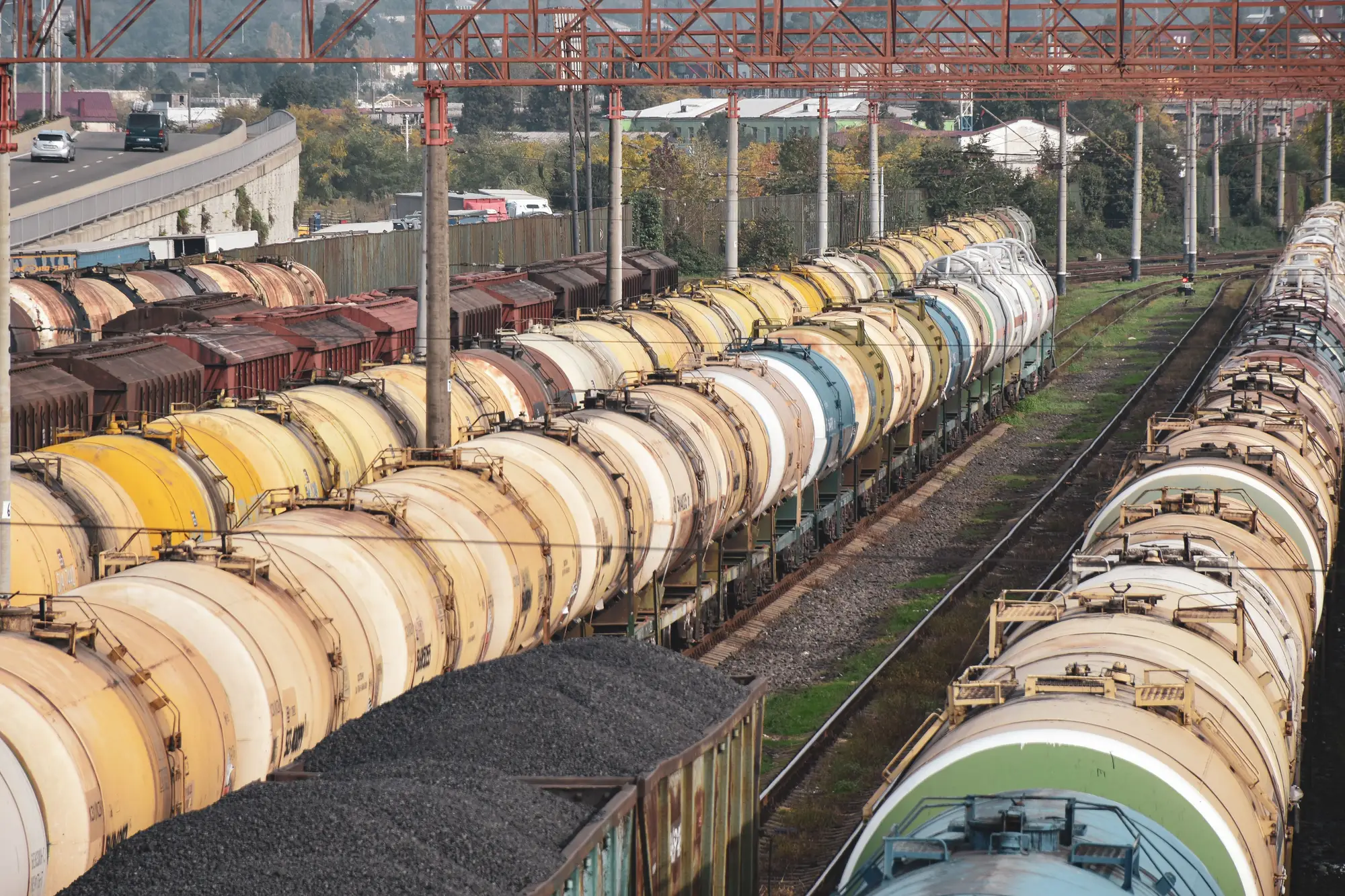
When an aerial frame comes back over a yard or a stretch of mainline, the first thing most analysts want to know is what kind of train they're looking at. A unit train and a manifest train read very differently from directly overhead, once you know what to look for.
Unit train identification from overhead
A unit train is built from one car type, often one commodity, running point to point without being broken up at a classification yard. Coal trains, grain trains, crude-by-rail sets, and aggregate trains are the common examples. Seen from directly overhead at sub-meter resolution, a unit train shows up as a long, uniform string: same car length, same roof line, same coupler spacing end to end. Count fifteen cars and they all measure out to the same pixel length, and you're almost certainly looking at a unit consist. Tank cars running in a block, open-top hoppers loaded with aggregate, covered hoppers in a grain train, these all produce a repeating pattern that's easy to pick out even in a single pass. You can't read placards from space, so the tell is repetition: car length and spacing holding steady head end to rear.
Manifest train rail yard patterns
A manifest train is assembled car by car from whatever shippers have booked, so the consist is mixed: boxcars next to tank cars next to centerbeam flats next to the occasional auto rack. In a rail yard, a manifest train's presence usually shows up as irregular car lengths and inconsistent spacing along a track, because cars built for different loads have different underframe lengths and coupler reach. A manifest string sitting on a classification track or a receiving track also tends to show partial blocks broken up by gaps, since it's often built in stages as cars arrive from different originating yards.
The practical test takes a minute: measure three or four consecutive cars on a string. If the lengths vary by more than a car length or two and the profiles differ, some with visible hopper slopes, some flat-roofed, some tank-shaped, you're looking at a manifest consist rather than a unit train.
Train consist overhead imagery: what you can and can't read
Overhead imagery at VHR resolution gives you car count, car type by silhouette, and siding occupancy. It doesn't give you reporting marks, commodity contents, or billing information, and that shapes how you use the read. A unit train count tells you how many loaded hoppers moved through a yard that week. A manifest count on a given siding tells you how many cars of each visible type are sitting there right now, which is often the number a yard manager actually needs when a siding is supposed to be clear for an inbound set and isn't.
One thing that trips up analysts new to overhead car counting: locomotive consists at the head end look about the same whether they're pulling unit or manifest traffic, so power isn't the tell. Look at the cars behind it instead.
Seasonal unit trains also help confirm themselves over time. A grain train in harvest season or an aggregate train tied to a construction push will show the same car type repeating on the same siding across several weekly reads, not just one frame. That recurring pattern is a second confirmation beyond a single image, and it's the kind of thing that's easy to miss if you're only looking at the yard once a month.
For a yard that handles both unit and manifest traffic on shared trackage, the harder problem isn't a single image. It's keeping the count straight week over week, across every siding, without someone walking the tracks with a clipboard. Rail Yard Counts was built for exactly that: a weekly read of the yard footprint that counts rolling stock by type and reports occupancy siding by siding, so the patterns above become something you check on a yard map instead of something you eyeball from one frame.
If your network doesn't have a ground-truthed inventory system and you're done guessing consist mix from memory, a weekly siding-by-siding read is worth a look.