26 October 2026
Tank car vs covered hopper: reading rail car silhouettes from overhead imagery
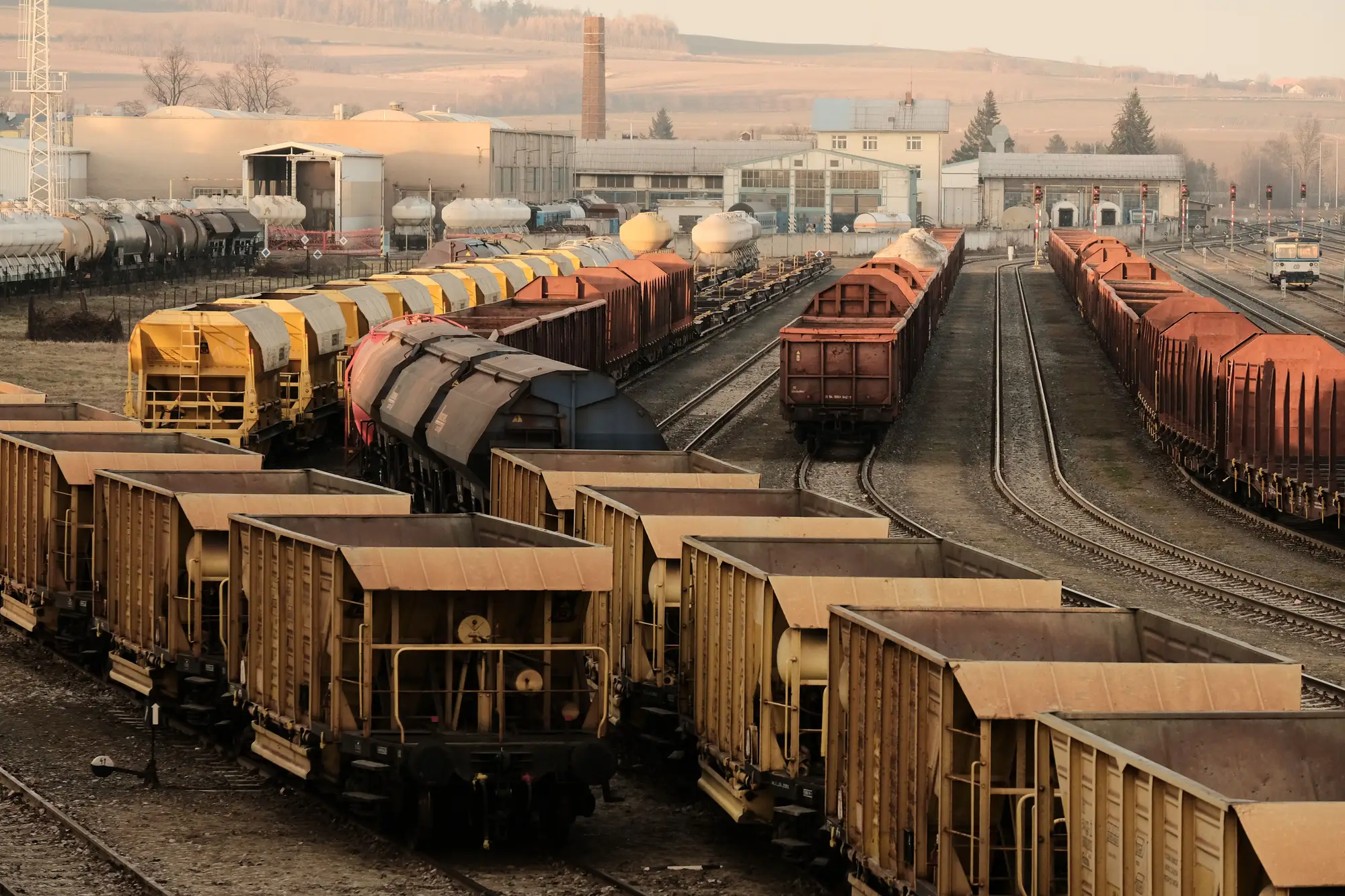
If you've ever tried to call rolling stock type off a VHR frame, you know the problem isn't resolution so much as habit. At 0.5 m GSD a tank car and a covered hopper can both come out as a roughly 50-foot gray oblong with no markings legible. The trick is reading the oblong the way a mechanical inspector reads a consist from trackside, by shape, shadow, and what sits on top.
Shape is the first tell
A tank car reads as a true cylinder laid on its side. From directly overhead that gives you a clean, even-width rectangle with rounded ends, almost no visible roof detail beyond a dome or a couple of small fittings near the center. There's often a slight bulge where the tank is widest, usually dead center or just off it, and the ends taper rather than square off. Non-pressure tank cars (GATX-style, insulated, the kind hauling crude or ethanol) run longer and thinner than pressure tank cars carrying LPG or anhydrous ammonia, which tend to be shorter and fatter for the same capacity.
A covered hopper looks boxier the whole way down. You'll see a ridged or segmented roofline where the hatches sit, usually three to five discrete humps running the length of the car rather than one smooth curve. The car body itself reads flatter on top, closer to a trapezoid in cross-section than a circle. Covered hoppers also tend to show a visible sloped-end profile at the discharge gates, which on high-resolution frames shows up as a faint notch at each end of the car, something a tank car never has.
Shadow and width give you the rest
When the shape alone isn't decisive, usually because the sun angle is flattening contrast or the car is partially shadowed by a neighbor, shadow geometry closes the gap. A cylindrical tank car throws a shadow with a soft, curved edge along its length, the shadow line itself bowing slightly rather than running straight. A covered hopper's shadow follows the hatch ridges, so you get a faint sawtooth pattern along the shadow edge instead of a smooth curve. On a low sun-angle pass this sawtooth is often clearer than the roofline itself.
Width consistency is the other giveaway. Tank cars hold a near-constant width for nearly their full length and only narrow right at the coupler ends. Covered hoppers narrow more gradually toward each end, following the slope of the discharge section, so the car reads slightly tapered even well inboard of the trucks. Line up ten cars on the same siding and this difference gets easy to see fast, even without perfect nadir geometry.
Where this still gets mixed up
Short covered hoppers (the 4,750-cubic-foot grain cars, not the big cement or plastics pellet cars) are the one case worth double-checking. At under 50 feet they can look almost as compact as a short pressure tank car, and if the hatch ridges fall in shadow you lose the roofline tell. In that case, lean on the shadow sawtooth and the end taper rather than overall length. Mixed consists on an interchange track, where tank cars and hoppers sit nose to nose, are often easier to call than a solid block of one type, because you've got a direct length and width comparison sitting right next to the car you're unsure about.
None of this replaces a yard clerk walking the track with a waybill, and nobody's claiming a satellite pass tells you what's inside the tank. What it does tell you is how many of each car type sit on which siding, counted the same way every week, which is most of what a network analyst needs for turnaround and dwell work. That's the read Rail Yard Counts delivers against repeat VHR imagery: a yard-map overlay with per-siding occupancy and a wagon count by type, for yards that don't have a ground-truthed inventory system to check against. If a particular siding's car mix is something you're trying to track week over week without walking it, that's worth a look.